
HSflow™ – Human Sustainability Measurement für CSRD 2026
The standardised measurement instrument for collecting auditable human sustainability indicators – as the foundation for your reporting.
Human Sustainability Reporting 2026
From 2026 onwards, companies are required to provide measurable evidence of human sustainability.
With the introduction of the CSRD, psychosocial risks, human stability and stress factors become subject to mandatory audit requirements for the first time. However, most organisations currently lack a recognised method for objectively collecting this data.
HSflow closes this exact gap:
It is the first standardised measurement procedure for human sustainability. Developed for CSRD reporting – standardised, anonymous and auditable.
According to the CSRD, human sustainability includes the assessment of psychosocial risks, stress factors, stability and health indicators within the workforce.
Companies gain a solution that:
- delivers verifiable human sustainability KPIs
- does not rely on self-assessment
- operates fully anonymously and in compliance with the GDPR
- is scientifically validated
- can be integrated directly into sustainability reports
Why Companies Without HSflow Will Retain a CSRD Gap
- Psychosocial risks become subject to audit from 2026 (CSRD / ESRS S1).
- Existing tools are based on self-assessments and are not auditable.
- Auditors require objective evidence of stress factors and mental health risks.
- Until now, no standardised measurement procedure existed for this area.
HSflow is the first method to fully close this gap.
Which Human Sustainability Indicators the HSflow™ Measurement Instrument Captures
HSflow™ is a measurement instrument.
It does not replace reporting software and does not generate sustainability reports.
It provides the robust, auditable data foundation on which your reporting is built.
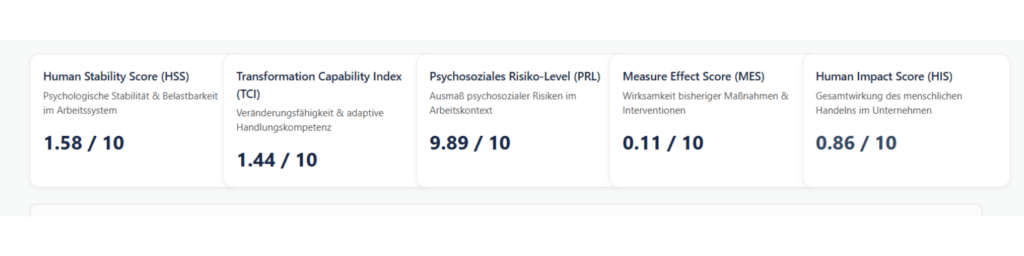
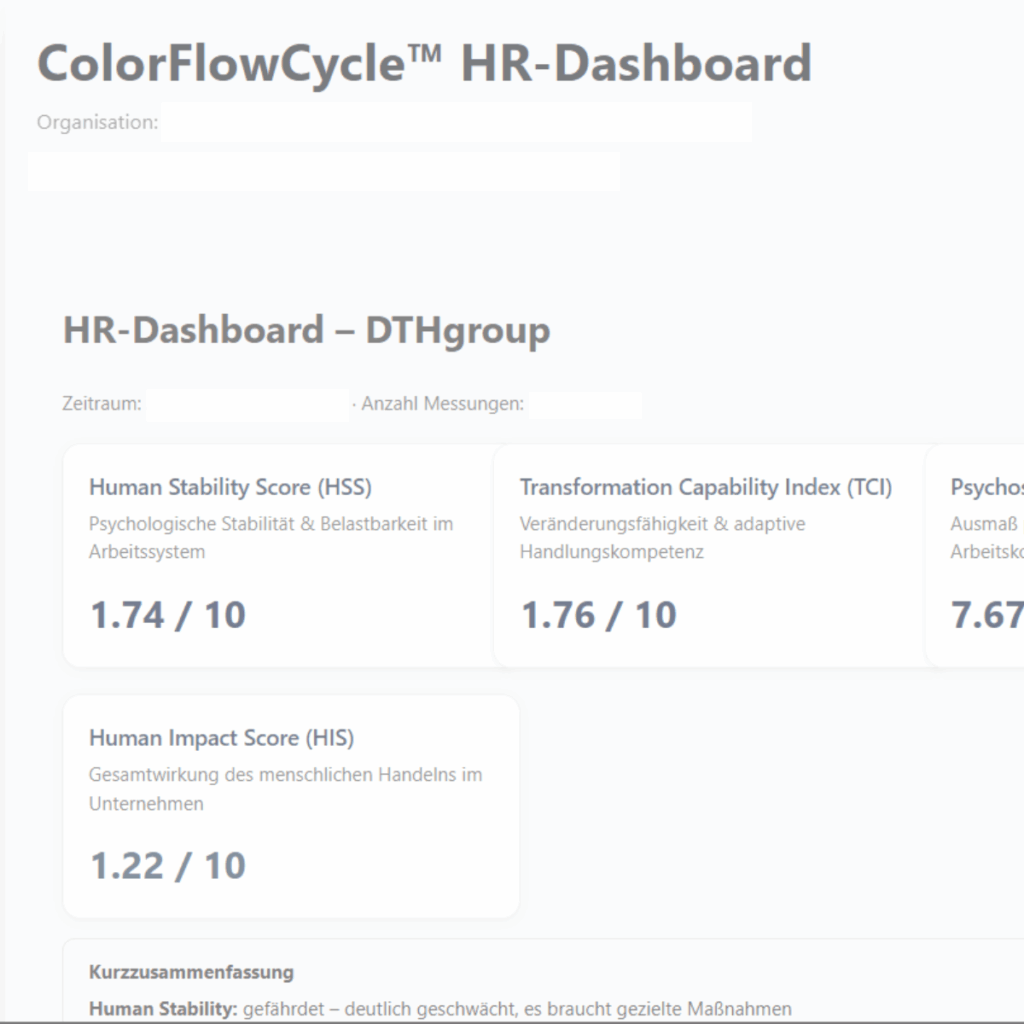
HSflow measures the following key parameters required for CSRD reporting that were previously unavailable:
✓ Human Stability Score (HSS)
Stability, regulation, focus, stress tolerance.
✓ Psychosoziale Belastungsindikatoren
(MES, PRL, TCI)
Early warning signals for stress, exhaustion and dysregulation.
✓ Transformationsfähigkeit
Ability to deal with change, adaptability, implementation capacity.
✓ Human Impact Score (HIS)
Organisational stress pressure, risk indicators, need for change.
Why Human Sustainability Cannot Be Assessed Without a Measurement Instrument
Human sustainability is not only a regulatory requirement – it is a key component of modern corporate governance.
Today, organisations must not only report data, but actively understand and stabilise the condition of their workforce in order to:
- identify psychosocial stress at an early stage
- systematically protect mental health
- reduce risks such as burnout, overload or silent attrition
- increase organisational stability
- secure performance and transformation capacity
HSflow provides, for the first time, a precise, scientific and auditable measurement procedure that can be directly integrated into governance and prevention systems.
Human sustainability thus becomes not only reportable, but a strategic leadership instrument.
Extended Human Sustainability KPIs – for Prevention and Organisational Stability
With HSflow, companies can additionally integrate relevant baseline data such as FTEs, absence rates, sickness levels, fluctuation and personnel costs.
These data not only enhance the explanatory power of reporting, but also enable preventive analyses, for example:
- identification of stress hotspots
- detection of dysfunctional patterns in teams or departments
- derivation of concrete stabilisation measures
- evaluation of the effectiveness of health and prevention programmes
HSflow thereby connects compliance (CSRD/ESRS) with prevention, leadership and organisational development.
Meets Core Requirements of ESRS S1 (Own Workforce)
HSflow enables companies to reliably capture the psychosocial risks, stress factors and mental health indicators required under the ESRS standard (ESRS S1 – Working Conditions).
The resulting human sustainability data particularly supports:
- S1-6: Health & safety – psychosocial risks
- S1-3: Workload, organisational factors, stress indicators
- S1-1: “Own workforce” – systemic stability and risk patterns
HSflow thus provides a verifiable and auditable component for fulfilling the social disclosure requirements under CSRD / ESRS.
The Scientific Standard Behind It – Measurable, Preventive, Organisationally Relevant
HSflow is based on the ColorFlowCycle®, a neuroscientific model for capturing regulation, dysregulation and stress patterns.
This enables organisations to:
- identify early warning signals
- make stress reactions visible
- quantify stability and capacity for action
- measure transformation capability
The system makes preventive health measurable for the first time – without collecting personal data.
Your Measurement Basis for CSRD-Compliant Reporting – Auditable, CSRD-Ready
With HSflow, companies receive all human sustainability data required for reporting from 2026 onwards:
- HR dashboard with all scores
- KPI time series
- early warning indicators
- stress factors
- anonymised overall views
- scientific documentation
The data can be directly integrated into existing sustainability and reporting tools.
No new software landscape. No process disruption.
Why Companies Cannot Wait Until 2026 – Also from a Preventive Perspective
- Psychosocial risks become subject to audit from 2026 (CSRD / ESRS S1).
- Auditors require valid evidence – self-reports are no longer sufficient.
- Missing data creates compliance and liability risks.
- Early warning signals are recognised too late in many organisations.
- Overload and silent resignation are costly – prevention significantly reduces costs.
Companies that start early do not only secure their reporting – they stabilise their organisation, their teams and their future viability.
HSflow™ Measurement Pilot 2025 – Request Access
Collect auditable human sustainability indicators with HSflow™ for CSRD 2026.
In 2025, companies can secure a pilot slot and implement the procedure before the first reporting year.
→ participating companies receive preferential annual conditions
→ documentation adapted to audit requirements included
→ full use of measurement and dashboards
Would You Like to Receive Information First?
For Companies from 2027 Onwards
Licence pricing will be published in summer 2026.
Pilot partners receive guaranteed preferential conditions